
Focus Areas - Digital Skills
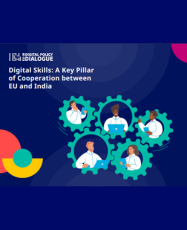
Digital Skills: A Key Pillar of Cooperation between EU and India.
Digital Skills
Context
In today’s digital era, digital skills, from basic literacy to advanced competencies in AI, cloud computing, semiconductor production, high performance and quantum computing, and 5G/6G technologies are critical for innovation and competitiveness. Yet rapid technological change and mismatches between education systems and labour market needs have created significant skills gaps in the ICT sector.
In the EU, 10 million ICT specialists account for 4.8% of total employment, yet the number is projected to fall short of the Digital Decade target of 20 million by 2023, leaving a potential deficit of 7.8 million specialists if unaddressed. This challenge is further compounded by a gender disparity, with women currently representing only 18% of ICT specialists. In India, 1.5 million engineers graduate annually, yet only 10% secured high-quality jobs in 2024, and just 45% posses industry-relevant digital skills.
Both regions are responding through targeted digital skilling initiatives. In India, institutions such as the National Institute of Electronics and Information Technology (NIELIT) play an important role in strengthening the digital skills ecosystem. These complementary efforts highlight a strong mutual interest in advancing digital skills development and enabling talent mobility, creating opportunities for win-win cooperation between the EU and India.
The EU–India Trade and Technology Council and the High-Level Dialogue on Migration and Mobility provide key frameworks to advance cooperation on skills and talent exchange. Initiatives such as the European Legal Gateway Office pilot, launched in India on the sidelines of the AI Impact Summit in February 2026 following its announcement at the 16th EU–India Summit, further support these efforts by providing clear information on mobility pathways and ICT skills requirements for skilled Indian professionals.
Objectives
-
Promote structured exchanges between the EU and India on advanced digital skills across priority technology areas.
-
Facilitate multi-stakeholder dialogue addressing opportunities and challenges related to talent mobility and skilled migration between the two regions.
-
Strengthen platforms linking Indian academic institutions, EU labour market needs, and industry partners to facilitate talent exchange, share best practices, and support EU industry engagement with Indian digital talent.
Our Approach
-
Workshops and peer-to-peer exchanges addressing digital skills gaps, best practices in developing joint programmes and skills qualification frameworks.
-
Finding synergies with existing digital skilling initiatives by EU Member tates and European companies operating in India.
-
Research on EU-India digital identity interoperability, enabling the mutual recognition of academic and professional credentials.
Current State of Cooperation
A mapping exercise of EU member states and their digital skilling activities in India indicates that four member states (Estonia, Germany, the Netherlands, and Sweden) have active digital skilling MoUs, while three member states (Finland, France, and Poland) have international programs with potential for scaling to other regions.
Existing skilling programmes of EU companies in India can be broadly classified into 4 categories (and are largely funded by corporate social responsibility initiatives targeting underprivileged youth and women.
The Global Legal Gateway will be piloted in India to ease skilled migration for digitally skilled Indian talent. Exchanges with the EU Member States and the sharing of best practices is ongoing.
Key Areas for Further Collaboration
- Structured mechanisms for skilled migration, including support for initiatives such as the European Legal Gateways Office pilot in the ICT sector.
- Mutual acceptance of ICT academic and skills credentials, including the development of an EU–India interoperability sandbox plan to test practical implementation.
- Bilateral sharing of skilling initiatives, policy models and programme outcomes.
Moving Forward
- Building on the initial alignment efforts and exploratory activities already underway, the EU-India Digital Policy Dialogue will move toward more structured and outcome-driven collaboration on digital skilling.
- Workshops and technical exchanges with the EU AI Office, including engagements held on the sidelines of the AI Impact Summit 2026, are helping translate strategic discussions into practical next steps. Continued engagement with experts, academia, and business stakeholders will ensure that diverse perspectives inform future cooperation.
- These efforts aim to operationalise shared priorities, generate scalable cooperation models, and support the development of an EU India talent pool and pathways for talent mobility.
Publications