Events
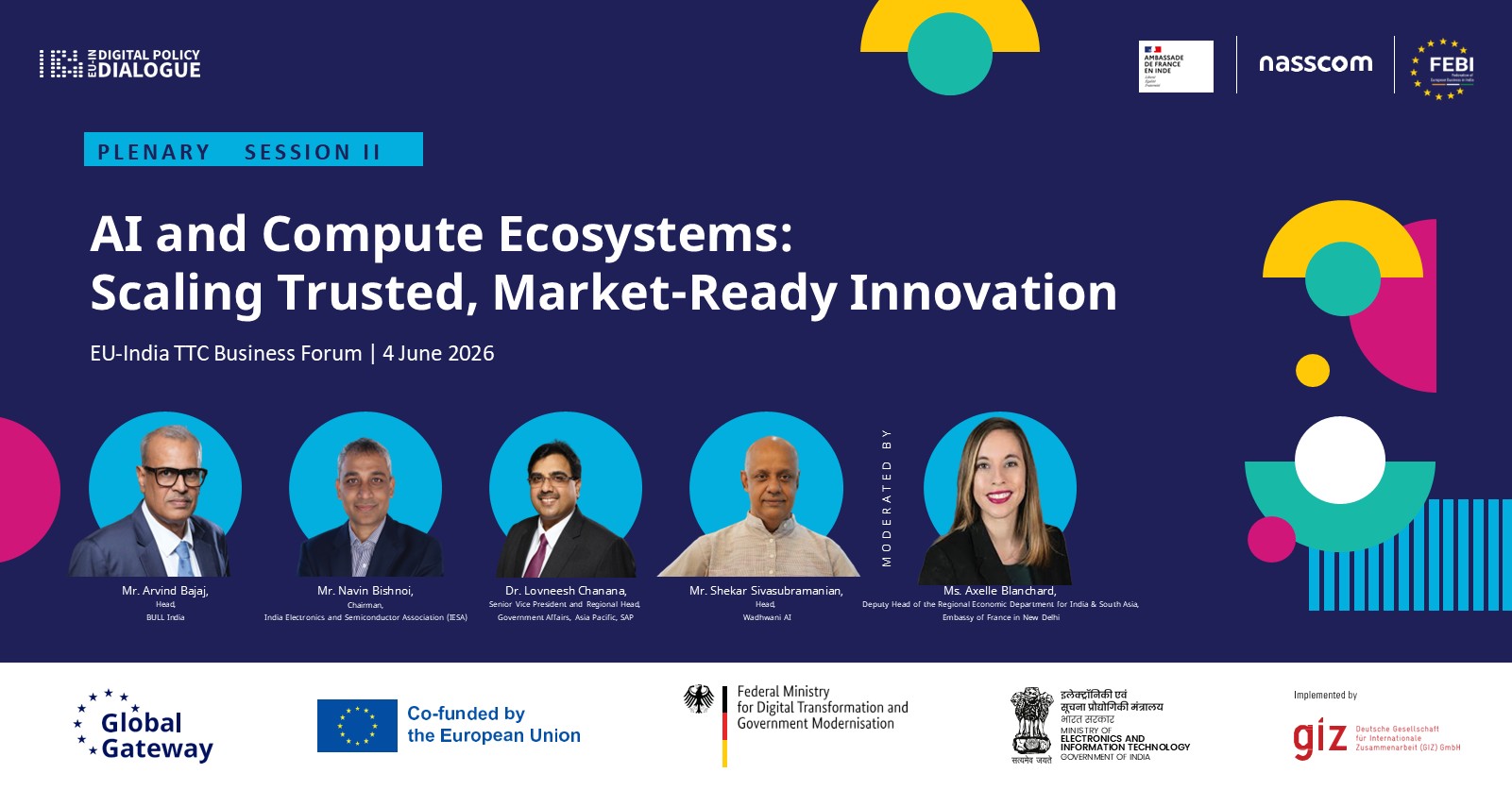
AI and Compute Ecosystems: Scaling Trusted, Market-Ready Innovation
Artificial intelligence is a production technology reshaping healthcare, agriculture, manufacturing, public services and financial systems simultaneously, and both India and the European Union are deploying it at scale.
EU India AI cooperation has moved decisively from dialogue to delivery, and Europe is now emerging as an operational partner in India’s AI trajectory rather than a policy interlocutor. Member State engagement illustrates the breadth of this shift: Germany, France, Finland, Sweden and Estonia each deepened their bilateral AI engagement with India at the India AI Impact Summit 2026. Sarvam-M, built on Mistral’s open-weight architecture, illustrates how Europe’s open-source AI stack has become a foundational enabler of India’s sovereign AI ambitions, a dependency that itself carries significant strategic meaning for the future shape of the partnership.
The Indo-French Centre on AI in Global Health (IF-CAIH), inaugurated at AIIMS New Delhi in the presence of President Emmanuel Macron and the Union Minister of Health and Family Welfare bringing together AIIMS, Sorbonne University, the Paris Brain Institute and IIT Delhi marks a first-of-its-kind European initiative on AI in healthcare. These bilateral milestones are reinforced by structured frameworks such as the Indo-French Innovation Network, launched in Mumbai on 17 February 2026, the Station F/HEC Paris India acceleration track (ten start-ups, over €42 million raised, 36 EU partnerships) whose second cohort was announced in April 2026 across areas including health tech, climate tech, edtech, satellite intelligence and cognitive AI. Additionally, Europe’s emerging sovereign compute ecosystem around Current AI, Mistral, Scaleway and OVHcloud, these initiatives demonstrate that the European offer to India is no longer aspirational, but increasingly institutionalised, funded and politically endorsed at the highest level. The task of the EU–India TTC is now to weave this constellation of national efforts into a coherent, EU-wide partnership capable of matching the scale of India’s ambition. The EU AI Act, progressively entering into force through 2027, is becoming a global governance reference. EU companies that build to its standards carry a trust signal competitors cannot replicate. Indian companies accessing EU markets need AI products that are compliant from day one. The EU–India Trade and Technology Council is actively mapping convergence between the two frameworks.
This session explores how to turn that complementarity into concrete business and research partnerships, co-developed applications, shared compute access, joint governance frameworks and a pipeline of AI products that work across the EU–India corridor.